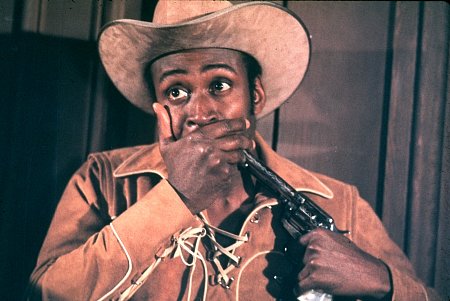
The wonderful (read: unnecessary) thing about reviewing a classic film, a classic comedy no less, is that it is already accepted as great and significant, regardless of what a viewer’s two cents might say otherwise. I’m late to the party, as it were. If I were to praise the film, I would just be adding superfluous fuel to the “blazing” fire. If I were to bash the film, it is quite obvious something is wrong with me. And if I only like the film, and don't grovel at its suggested genius, I would be deemed a Nazi. Luckily there are Nazis in said film, so I don’t feel too bad about that.
The greatest enduring feature of Mel Brooks’ Blazing Saddles is its gleefully satirical impoliteness. It’s a traditional-looking Western about a corrupt state official, Hedy- I’m sorry- Hedley Lamarr, who appoints a black sheriff to scare away the racist townspeople of Rock Ridge so he can buy the land. Innuendo, and other ways of being offensive without being raunchy, is a lost art in cinema. The best comedies of the last few years, including Superbad, Knocked Up, and The Hangover, all heavily rely on subversive humor that includes penises, drugs, and a whole lot of F-bombs. However, by my count, none of these three films feature a white character calling a black character the N-word (I won’t even type it!). In fact, I don’t even think any major studio has the cojones to do that in a movie these days (except for maybe a period piece in a dramatic context). Brooks’ brash brandishing of the term is not only offensive, but sometimes outright hilarious. Especially when an old lady says it.
Apart from the political incorrectness of the whole thing, Brooks’ style of humor is really something to behold. Satire and innuendo have essentially been eliminated from current mainstream comedies. Brooks also has a way of throwing every type of humor at the screen, including slapstick, breaking the fourth wall, anachronisms, fart jokes, musical numbers, and metaphysics. Once again, not particular of current Hollywood. Speaking of Hollywood, the all too frequent pat-yourself-on-the-back institution gets some satirical justice, which is very welcome and refreshing. Its treatment of the Western genre is equally honoring and critical.
One of the benefits of reviewing a classic is you get to write about the ending, because chances are if you’re reading reviews of a 40 year old movie, you’ve probably seen it by now. The most classic thing about Blazing Saddles is its absurd ending (yes, I know the hangman is classic too). When Lamarr’s gang of bikers, Nazis, Klansmen, Arabs and rapists fight the people of Rock Ridge in a climactic battle, they break out of the film lot where the movie is being shot and wreak havoc on the set of a musical and, eventually, all of Warner Brothers Studios. It’s a perfect ending to a pretty funny movie, a movie that will endure as one of Mel Brooks’ defining classics. And that places Blazing Saddles in some pretty good company.
With Biutiful, director Alejandro González Iñárritu makes a steep narrative departure from his previous films; dissimilar to his well-received directorial (and production) efforts in both 21 Grams and Babel, Iñárritu withholds his typically sprawling, occasionally chaotic storytelling structure and focuses his lens solely on Uxbal (a brilliant Javier Bardem): single father to two young children, separated husband to a parentally negligent wife, career criminal, psychic communicator to the afterlife, late-stage cancer patient, and wonderfully-caricatured tragic hero. In this role, with Iñárritu’s undying focus upon him, and under the weight of a demanding, often agonizing script, Bardem shines, gracing the viewer with a towering achievement of his craft. In navigating his world—a gritty, urban Barcelona—Bardem displays the same thespian chops that were just as evident as in No Country for Old Men (for which he took home a well-earned Oscar; Bardem was also nominated for 2000’s Before Night Falls, as well as this year for Biutiful). Also worth praising is Maricel Álvarez’s convincing portrayal of Marambra, a pitiful parent, likely narcissist, and Uxbal’s separated wife. Yet while Biutiful succeeds triumphantly with its lead performances, it falls conceptually flat. Splitting writing credits with Armando Bo and Nicolás Giacobone, Iñárritu has written a tale appropriately rife with terse, occasionally powerful dialogue. The film and its script otherwise suffers the plight of pretension, expressing too heavily on themes of perseverance and the vain morality inherent of being criminal. Where the filmmaker wishes to dynamically convey suffering through what nearly amounts to a contemporary retelling of the narrative of the Book of Job (which has been done quite recently, and acted quite successfully by Michael Stuhlbarg, of HBO renown), Iñárritu's failure is in creating a setting where story can actually happen. Rather, the viewer is offered a Spanish ghetto (one very well-shot with cinematographer Rodrigo Prieto's gritty, charged lens) with scene upon scene of variously terrible, irksomely contrived fates affecting the protagonist and the rest of the cast. The film moves quickly, and probably recklessly, from a bleak tale of a father's enduring will to care for his children against his impending early death, a faltering illicit enterprise and the burden of speaking for the dead (apologies to Orson Scott Card), to a movie in which the viewer realizes that not only will nothing good happen, but seemingly nothing good can happen. If anything, one may find the film comically bleak and unyielding; truly every single effort by the altruistic Uxbal to make life better for himself, for his young children, or for the illegal immigrants he is responsible for harboring, is answered, universally, with a consequence even more depressing than the one preceding it. And the film goes on, and on...and on. At a trying 148 minutes, the present critic found himself checking his watch several times, as much as from a strong desire to more or less end such narrative masochism as from being the consequence of watching a film that wanes considerably in most of its second and third acts. Do not, however, mistake the film's shortcomings in mood and plotting for what is an altogether very good artistic effort. Bardem is, as always, to be savored. And while bleak, the setting is absorbing, and for much of the first act, what will eventually become depressingly difficult to stomach is heartrendingly dramatic.